
Noticing a new spot on your skin can be unsettling, especially when it doesn’t heal, keeps bleeding, or slowly grows over time. You might wonder, Is this skin cancer? And if it is, what happens next? Basal cell carcinoma (BCC) is the most common type of skin cancer, and while it’s usually highly treatable with Mohs surgery or other procedures, early diagnosis is key to preventing deeper damage and scarring.
At Manhattan Dermatology, patients receive expert skin cancer care from leading board-certified dermatologists, including fellowship-trained Mohs surgeon Dr. Wendy Long Mitchell. With two convenient New York City locations and a team of NYU dermatology professors, you can count on thorough, compassionate care from diagnosis through treatment.
What Is Basal Cell Carcinoma?
Basal cell carcinoma is a type of skin cancer that develops in the basal cells, the cells that form the deepest layer of the outer skin. It most often occurs after years of UV exposure from the sun or tanning beds.
BCC typically grows slowly and rarely spreads to other parts of the body, but it can become larger and more destructive if left untreated. Some basal cell cancers can invade nearby tissue, damage nerves, and cause more noticeable scarring when removed later.
Basal cell carcinoma often appears on:
- The face (nose, cheeks, forehead, eyelids)
- The scalp
- The ears
- The neck
- The shoulders and upper back
Signs of Basal Cell Carcinoma
Basal cell carcinoma doesn’t always look the same, which is why professional skin checks are so important. Many people mistake BCC for a pimple, bug bite, or harmless scar.
Common warning signs include:
- A shiny, flesh-colored bump or growth
- A pearly or translucent spot with visible blood vessels
- A sore that bleeds or crusts and doesn’t heal
- A flat, scaly patch that may look pink or red
- A scar-like area that looks smooth, white, or waxy
- A spot that itches, hurts, or feels tender
If you notice any of these changes, it’s important to see a dermatologist right away for evaluation.
How Is Basal Cell Carcinoma Diagnosed?
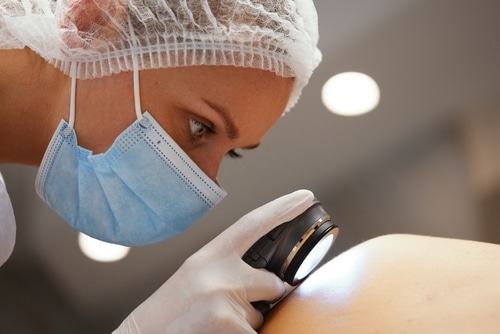
Diagnosing basal cell carcinoma starts with a close look at the area of concern. During a skin cancer screening, our dermatologists examine the lesion’s appearance and location and ask about changes you have noticed, such as growth, bleeding, or difficulty healing.
If the spot has features that could indicate skin cancer, we may recommend a biopsy. This involves taking tissue from the suspicious area so it can be examined to determine whether cancer cells are present. We perform biopsies of concerning lesions in the office as part of our skin cancer evaluation services.
A biopsy provides information that cannot be confirmed from appearance alone. Once basal cell carcinoma has been identified, we can use the results along with the location and characteristics of the lesion to determine the appropriate next step. In some cases, Mohs surgery may be considered when conserving as much healthy tissue as possible is particularly important.
Our skin cancer expertise includes Wendy Long Mitchell, MD, FAAD, FACMS, who is double board certified in dermatology and Mohs micrographic surgery and has advanced training in skin cancer treatment. If you have already been diagnosed with BCC, you can also read more about why basal cell carcinoma should be treated.
Treatment Options
Basal cell carcinoma treatment depends on where the cancer is located, how deep it is, and whether it’s recurring. The goal is always to remove the cancer completely while preserving healthy skin and minimizing scarring.
Treatment options may include:
- Mohs surgery (often recommended for the face or high-risk areas)
- Surgical excision (removing the cancer with a margin of healthy tissue)
- Curettage and electrodesiccation (scraping and sealing smaller lesions)
- Topical medications for very superficial cases
- Cryotherapy (freezing) in select situations
Mohs micrographic surgery is often considered the gold standard for BCC in visible areas because it offers the highest cure rates and preserves the most tissue.
Why Choose Manhattan Dermatology
When it comes to skin cancer, you want a team that combines experience, precision, and personalized care. Manhattan Dermatology is a trusted NYC destination for comprehensive medical dermatology, including in-office skin cancer diagnosis and removal.
Patients choose Manhattan Dermatology for:
- Board-certified dermatologists with advanced training in skin cancer care
- Fellowship-trained Mohs micrographic surgery expertise with Dr. Wendy Long Mitchell
- NYU faculty physicians — all providers are dermatology professors at NYU
- Two convenient Manhattan locations on Park Avenue and East 36th Street
- On-site care from diagnosis to treatment and follow-up
- Full-spectrum dermatology services, including chronic condition management (eczema, psoriasis, rosacea) and cosmetic treatments like Botox®, fillers, and laser resurfacing
- Flexible scheduling and availability for new patients
Basal cell carcinoma is also closely tied to preventive care — and Manhattan Dermatology makes it easy to stay proactive with routine skin checks and ongoing monitoring.
Have a Suspicious Spot Checked in New York, NY
Changes such as repeated bleeding, continued growth, or a sore that does not heal are worth having examined. Dr. Wendy Long Mitchell and our team at Manhattan Dermatology evaluate and treat skin cancer in New York, NY. Contact us or call 212-683-6073 for our East 36th Street office or 212-689-9587 for Park Avenue