

A rough patch that repeatedly crusts, a sore that does not heal, or a new growth on sun-damaged skin may be easy to dismiss at first. These changes can sometimes indicate squamous cell carcinoma (SCC), a common form of skin cancer that can grow into deeper tissue when left untreated.
Our physicians at Manhattan Dermatology diagnose and treat SCC in New York, NY. Wendy Long Mitchell, MD, FAAD, FACMS is double board certified in dermatology and Mohs micrographic surgery and completed fellowship training in Mohs and reconstructive surgery.
What Is Squamous Cell Carcinoma?
SCC begins in squamous cells in the outer layer of the skin. Long-term ultraviolet exposure is a common contributor, although the disease can also appear in chronically irritated, scarred, or damaged skin and in people whose immune systems are weakened.
SCC has a greater potential to grow into deeper tissue or spread than basal cell carcinoma. Finding it early can simplify treatment and reduce the chance of more extensive disease.
What Can Squamous Cell Carcinoma Look Like?
The appearance varies. Possible signs include:
- A firm red or pink bump
- A rough or scaly patch that crusts or bleeds
- A sore that does not heal or repeatedly returns
- A wart-like growth
- An ulcerated or tender area
- A thickened spot on the lip
SCC frequently appears on the face, ears, scalp, neck, hands, or forearms because these areas receive substantial sun exposure. Precancerous actinic keratoses may also develop on chronically sun-damaged skin.
How Is Squamous Cell Carcinoma Diagnosed?
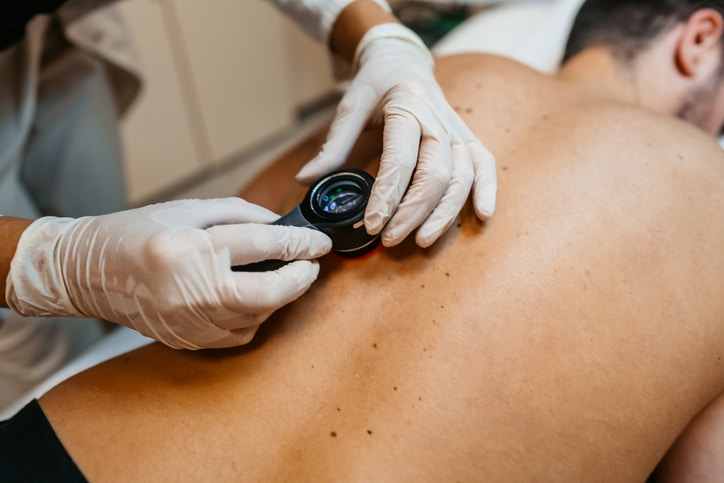
A suspicious appearance can prompt further testing, but skin cancer cannot be confirmed by sight alone. During a skin cancer evaluation, we examine the spot and consider its location, growth, symptoms, and your previous skin cancer history.
When SCC is suspected, a biopsy may be performed. Tissue from the area is examined to determine whether cancer cells are present and to gather information that can help guide the treatment plan.
How Is Squamous Cell Carcinoma Treated?
The approach depends on the size, depth, location, and risk features of the cancer.
Options can include surgical excision, curettage and electrodesiccation for selected lower-risk growths, and other treatments for certain superficial cases.
Mohs micrographic surgery may be recommended when SCC occurs in a high-risk or cosmetically sensitive area. During Mohs surgery, thin layers are removed and examined during the procedure. This allows the surgeon to continue until the margins are clear while conserving nearby healthy skin.
Why Choose Manhattan Dermatology for SCC Treatment in New York?
Dr. Mitchell completed fellowship training in Mohs micrographic and reconstructive surgery and has experience in skin cancer detection, biopsy, surgical removal, and long-term surveillance. She works alongside our board-certified dermatologists to evaluate suspicious areas and determine when surgical treatment is appropriate.
Having screening, biopsy, surgery, and follow-up available through the same practice also allows us to continue monitoring your skin after treatment.
Squamous Cell Carcinoma FAQs
Have a Suspicious Skin Growth Evaluated in New York, NY
A spot that continues to grow, bleed, crust, or return should be examined rather than watched indefinitely. Contact us to arrange an evaluation with Dr. Wendy Long Mitchell and our team at Manhattan Dermatology in New York, NY. Call 212-683-6073 for East 36th Street or 212-689-9587 for Park Avenue.